Author: Divya Prakash

  • Solutions to the Trilemma (BT.2)

    Picking up from the last post let’s look at some of the solutions to this trilemma. All solutions try to optimize one or more of the 3 elements- decentralization, security, and scalability.

    One solution comes from optimizing the nodes. But first, what is decentralisation?Blockchain networks like Bitcoin are designed in a decentralized nature such that there is no central authority, organization, or body in charge of network functioning. The network layer is available for anyone who wants to participate in the Blockchain. Thus the control of the network is fully distributed among participants rather than a single entity. Everyone on the Blockchain has access to the data on the chain, and if anyone tries to change the functioning or records to cheat, the participants have the vote to reject the data found at fault. Let’s take the example of the Bitcoin network to avoid technicalities in understanding decentralized architecture. No third party controls the Bitcoin network, unlike the traditional financial system in conventional banks. The third-party controls record to ensure that data is managed correctly and that transactional parties keep their transaction records safe.

    On the other hand, the Bitcoin Blockchain allows everyone on the chain to access the data and cross-check transactional records before these records are added to the digital database. This way, Blockchain technology creates a system without intermediaries to control the network and enforce trust between participants. However, transaction time increases in Blockchain networks as all the participants on the chain do data validation, and sometimes it can be slow due to how data is processed and shared on the Blockchain. (Source: https://www.blockchain-council.org)

    In a typical blockchain, all the nodes should be full nodes i.e. all nodes should have a complete independent replica of the chain and validate blocks and transactions. This is key to the chain being truly trustless and decentralized. We have already seen that since a blockchain, unlike an internet database is an append-only architecture, with time it becomes too large to have lots of nodes committing that kind of disk space. (for eg: a node of blockchain required about 400GB of disk space as per Statista, by mid-2022). To overcome this developers have come up with a solution where in instead of a full node you have a lightweight or partial node. Such nodes only keep the block headers instead of full blocks, to save on disk space but of course at the cost of decentralization (optimization problem..remember?). It is desirable to have more full nodes than light nodes in a blockchain. There are other variants and all types of terms which are some variant of a light node- such as Pruned Node, Sharding, etc. In the next one we will look at some other such solutions.


  • The Blockchain Trilemma (BT.1)

    BLockchain Trilema

    Like most things in life, Blockchain too has an optimisation problem which is known as the Blockchain Trilema. What is the problem?

    The blockchain trilemma is the concept that decentralization, security and scalability can’t all be represented in one blockchain. The term blockchain trilemma was coined by Vitalik Buterin, co-founder of Ethereum. Developers worldwide are experimenting by applying different scalability solutions and consensus mechanisms, including sharding and state channels.

    The three elements of the blockchain trilemma are decentralization, security, and scalability. The perfect blockchain boasts all three elements, but finding a balance between the three is difficult and presents a problem. For instance, it would be fantastic to have all credit card transactions flow on the blockchain network but why haven’t that happened already? Simply because, while maintaining Decentralisation and Security the Scalability suffers and suffers massively!. For perspective, the most common decetralised & secure blockchain application- the Bitcoin blockchain had a disk size of 406.05 gigabytes on July 10, 2022!!. Just imagine the problems such huge disk and data requirement this poses for Scalability. Every node that you add to the network, thereby improving the network’s security will require that diskspace. It is not easy to have such a distributed large network where every node can spare that kind of hardware resource. Also, it makes things painfully slow. For eg the block time (Time it takes to add a bloick in a blockchain) is about 10 minutes forBitcoin blockchain. Just imagine how slow would it be if we wanted to have all credit card or banking transactions on something like a Bitcoin blockchain.

    Now, ofcourse there are optimisation solutions for this problem. Some possible solutions include sharding, sidechains etc where one can focus on the more critical requirements, while kind of compromising on others. In essence, a simple Blockchain is not the solution to all use cases. Will talk about a few of these solutions in the next one.

  • Consensus Mechanism Contd..

    Picking up from where we left last; some more about the 2 most common mechanisms- PoW & PoS.

    Proof-of-Work (PoW) is a consensus mechanism that uses mining to validate transactions and create new blocks on a blockchain. Mining involves solving complex mathematical problems that require a lot of computational power and energy. The first miner who finds a valid solution gets rewarded with newly minted coins and transaction fees. PoW ensures that the network is secure and resistant to attacks, as anyone who wants to alter the blockchain history or create fraudulent transactions would need to control more than 50% of the network’s hashing power, which is very costly and impractical. PoW is most commonly used by Bitcoin.

    Advantages of PoW:

    • PoW is considered a more secure consensus mechanism as it is difficult for any single entity to control more than 50% of the network’s computational power.
    • PoW provides an incentive for miners to participate in the network, which helps to ensure that the network remains decentralized.
    • PoW has been widely tested and used in various cryptocurrency networks, making it a well-proven and reliable consensus mechanism.

    Disadvantages of PoW:

    • PoW is energy-intensive, which leads to high electricity consumption and carbon footprint.
    • PoW can also lead to centralization of the network, with a few large mining pools controlling a significant portion of the network’s computational power.
    • PoW can also be vulnerable to 51% attacks, in which a group of miners controlling more than 50% of the network’s computational power could potentially manipulate the blockchain.

    Proof-of-Stake (PoS) is a consensus mechanism that uses staking to validate transactions and create new blocks on a blockchain. Staking involves locking up some coins in a smart contract as a collateral that can be slashed if the validator behaves dishonestly or lazily. Validators are randomly selected to propose new blocks or vote on the validity of existing blocks based on their stake size and other factors. Validators get rewarded with transaction fees and sometimes newly minted coins. PoS aims to be more secure, energy-efficient, and scalable than PoW, as it does not rely on wasteful computations and reduces the risk of centralization and 51% attacks. PoS was first proposed as an alternative to PoW by Peercoin and later implemented by other cryptocurrencies such as Cardano, Tezos, and Ethereum

    Advantages of PoS:

    • PoS is less energy-intensive than PoW, which can reduce the carbon footprint of the network.
    • PoS can also be more decentralized, as validators with smaller amounts of stake can still participate in the network and earn rewards.
    • PoS can also be more resistant to 51% attacks, as a group of validators would need to control a significant portion of the network’s stake in order to manipulate the blockchain.

    Disadvantages of PoS:

    • PoS can lead to centralization of the network, with validators with the largest stake having the most influence over the network.

    Some of the main differences between PoW and PoS are:

    • PoW requires miners to expend energy and hardware resources, while PoS requires validators to stake coins as collateral.
    • PoW rewards miners with newly minted coins and transaction fees, while PoS rewards validators mostly with transaction fees and sometimes newly minted coins.
    • PoW adjusts the difficulty of mining based on the network’s hashing power, while PoS adjusts the stake size and other parameters based on the network’s participation rate.
    • PoW is vulnerable to 51% attacks if a malicious actor controls more than half of the network’s hashing power, while PoS is resilient to 51% attacks unless a malicious actor controls more than two-thirds of the network’s stake.
    • PoW consumes a lot of electricity and contributes to environmental issues, while PoS consumes much less electricity and has a lower carbon footprint.

    I hope this helps you understand the basics of Proof-of-Work (PoW) and Proof-of-Stake (PoS) consensus mechanisms. In the next post, will try to take a step back and talk about the Blockchain Trilemma.

  • What is ‘Consensus mechanism’ in a blockchain?

    The consensus mechanism is a crucial component of a blockchain project as it ensures the integrity and security of the network. It is responsible for reaching an agreement among all participants on the current state of the blockchain and the validity of new transactions. This is important for maintaining the trust and reliability of the blockchain network. In essence, consensus mechanisms are what impart the defining characteristics of a particular project/network. There are several types of consensus mechanisms that are used in different blockchain networks, each with its own strengths and weaknesses. The two most popular and widely used consensus mechanisms are: Proof of Works (PoW) & Proof of Stake (PoS) – more on them in detail, later.

    This is just a simple primer on the consensus mechanisms I have heard of. I cannot guarantee that all of the below mechanism make sense! But anyways, here they are-

    1. Proof of Work (PoW): This is the most widely used consensus mechanism, and is the foundation of the Bitcoin and Ethereum networks. PoW is a computational process that requires miners to solve complex mathematical problems in order to add new blocks to the blockchain. The first miner to solve the problem gets to add the next block and receives a reward in the form of new coins.
    2. Proof of Stake (PoS): This mechanism allows participants to “stake” or lock up a certain amount of their coins as collateral in order to validate transactions and add new blocks to the blockchain. The validators are chosen based on the amount of coins they have staked, and they are rewarded with transaction fees.
    3. Delegated Proof of Stake (DPoS): This mechanism is similar to PoS, but allows token holders to vote for a select group of validators, who are responsible for maintaining the blockchain. DPoS is designed to be more efficient and scalable than PoS, but is also more centralized.
    4. Proof of Authority (PoA) : PoA is a consensus mechanism where a group of validators is pre-approved by the network’s creator. These validators are responsible for verifying transactions and adding new blocks to the blockchain, and are often chosen based on their reputation or identity.
    5. Proof of Burn (PoB): In this mechanism, miners burn or destroy a certain amount of their coins in order to prove their commitment to the network. This process is used to determine which miner gets to add the next block to the blockchain.
    6. Proof of Elapsed Time (PoET): This mechanism is specifically designed for permissioned networks, such as consortium blockchains. PoET uses a random wait time to determine which miner gets to add the next block to the blockchain, but unlike PoW, it doesn’t require significant computational power.

    Since the technology is relatively new, new consensus mechanisms are still being developed and experimented with. As you would have heard already, the most common ones are PoS & PoW. More on them in the next post!

  • #ChatGPT & Sovereign Gold Bonds (SGB)

    Sovereign Gold Bonds (SGBs) are financial instruments issued by RBI that allows investors to buy gold in a paperless form. They are denominated in grams of gold and are issued in multiples of one gram. The primary purpose of SGBs is to reduce the demand for physical gold and encourage people to invest in paper form instead.

    One of the main advantages of SGBs is that they offer a safer and more convenient way to invest in gold. Unlike physical gold, SGBs are not subject to the risk of theft or loss. They are also easier to sell and can be traded on stock exchanges. In addition, SGBs offer a fixed rate of return, which is determined by the government at the time of issue. The current rate is 2.5% per annum, which is paid semi-annually.

    Another benefit of SGBs is that they are exempt from capital gains tax on redemption. This means that investors do not have to pay any tax on their profit when selling their SGBs. This is a significant advantage, especially in a country like India where taxes on capital gains can be quite high.

    SGBs are also attractive to investors because they offer a combination of both gold and debt. On one hand, they provide the security and stability of gold, which is considered a safe haven asset. On the other hand, they offer a fixed rate of return, similar to a debt instrument. This makes them an appealing option for investors looking to diversify their portfolios. It is important to note that SGBs are not the same as physical gold. They are simply a representation of gold and do not have any intrinsic value. This means that the price of SGBs is dependent on the market price of gold, which can fluctuate.

    In conclusion, Sovereign Gold Bonds are a convenient and tax-efficient way for investors to buy gold. They offer a fixed rate of return, are easy to sell, and are exempt from capital gains tax. While they may not have the same intrinsic value as physical gold, they offer a combination of gold and debt, making them a good option for diversifying a portfolio.

    What you read above is entirely written by #ChatGPT when asked- Write me a 300-word article on Sovereign Gold Bonds. There were 2 factual errors, which were edited out. Still, it makes a fantastic concise piece!

    Later I asked #ChatGPT to compare Gold prices against Fixed Deposits over the last 20 years, which it couldn’t and so here comes the human part.

    This product was launched by RBI in 2015 and since then has been offered multiple times over the years. Latest of which concluded on December
    23, 2022.

    SGB Data

    The question is, does SGB make a good investment?  I will answer this by
    comparing it against Fixed Bank Deposits (FD). So in case you aren’t invested
    in SGBs and hold FDs, do yourself a favor and read on.

    Since SGBs are intrinsically linked to Gold price, of course it is subject to market fluctuations and unlike FDs, might even deliver a negative return in certain years. FDs do deliver a guaranteed positive return but that statement is only valid if we are naïve to ignore inflation and only look at the nominal return instead of real return. If you subscribe to the macroeconomic idea that INR will keep depreciating against USD over longer periods, till there is an Inflation differential between the two economies. This return because of currency depreciation is in addition to any appreciation of Gold price (quoted in USD). To validate this, I looked at data for the period 1985-2022 and this is how it looks-

    Historical

    So Gold & SGBs in particular offer a better return over FDs. But is it enough of an incentive to subject yourself to the uncertainty vis-a-vis FDs? That’s a question one needs to evaluate based on investment goals and risk appetite.

    Now let’s do a comparison over a similar period. Since SGBs are an 8-year investment (there are options to exit before that but you lose on the tax benefit). Let’s look at the returns on both assets over rolling 8-year periods during 1985-2023.

    8 Year period

    You will see that out of 30 such periods, SGB emerges as the winner in 22 periods! That’s as good as an odd we can get. Also, SGBs on average return 75% higher over FDs over these 8-year periods. Now that’s a fantastic return and should be reason enough to persuade you to a reasonable allocation to SGBs over long-term FDs.

    Now some nuances for the nerds:

    1. The FD rates taken for comparison are average FD rates for 5-year Deposits by leading 5 Banks in those years. Source: RBI website
    2. Tax payable on interest income is assumed to be 20%. Which depends on your tax bracket. A higher tax rate is an advantage to SGB.
    3. Interest rate on SGB is considered @2.5%, even though it was 2.75% for the first series.
    4. You may download the excel files here (Historical Data- SGB) and tweak the nos as you please. 
    5. SGBs do not pose a reinvestment risk unlike FDs, depending upon the FD tenor you actually get from your bank.
    6. SGBs are an excellent tool if you want to take exposure to long-term currency depreciation (INR).


    P.S.: I agree the title of this post was somewhat misleading (#ChatGPT) but at least it got you to read, what otherwise would have sounded drab to start reading. Who wanted another post on SGB after all!

  • e-Rupee (e₹) or e-RUPI? (e₹UPI)

    Not being a wordsmith and these 2 are very different things! Short note on what’s what.

    So, first e-Rupee or e-₹; this is what has been the talk of the town for over a month now. Simply put, it is India’s CBDC (Central Bank Digital Currency) launched by RBI, which is currently undergoing its pilot. {If you still wondering what is that, welcome to the blog and may I implore you to go through last few posts here. I beleive, that will be sufficient for you to gain a decent undertsanding of e₹. }. With e-₹ out of the way, what the hell is e-₹UPI!

    Continuing with our long national tradition of creating clutter as much and wherever possible we have done it again! Jokes apart and to be fair, there wasn’t much room for having a better nomenclature for these 2. Anyways, this Seeta-Geeta business has got more than a handful mixing the two and serving it to people. The very reason I wanted to write on this, was because a few days back I came across this on youtube- https://youtu.be/My5pXiDCtU0 from Mr. Akshat Shrivastava. Great channel, superb content, and 1.35 mn Subs on Youtube alone! 10 days later this video has 304K views and 1500+ comments appreciating the content. The only hitch is that he has got it wrong, confusing e₹UPI as India’s CBDC.

    Don’t get me wrong, I love his content and general take on life but this was a reason enough to make an effort to limit the misinformation. Enough digression, back to the subject.

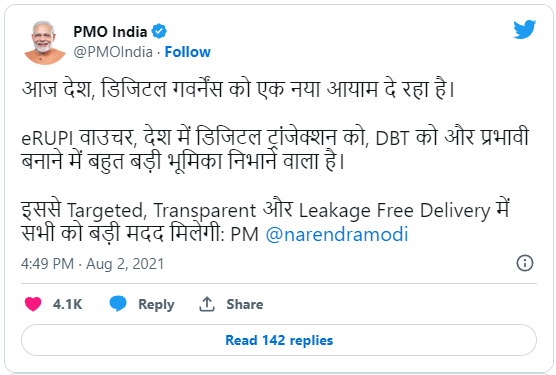
    e₹UPI was first announced by Prime Minister Narendra Modi on 2nd Aug 2021. Long before the e-Rupee (e₹) came into being.

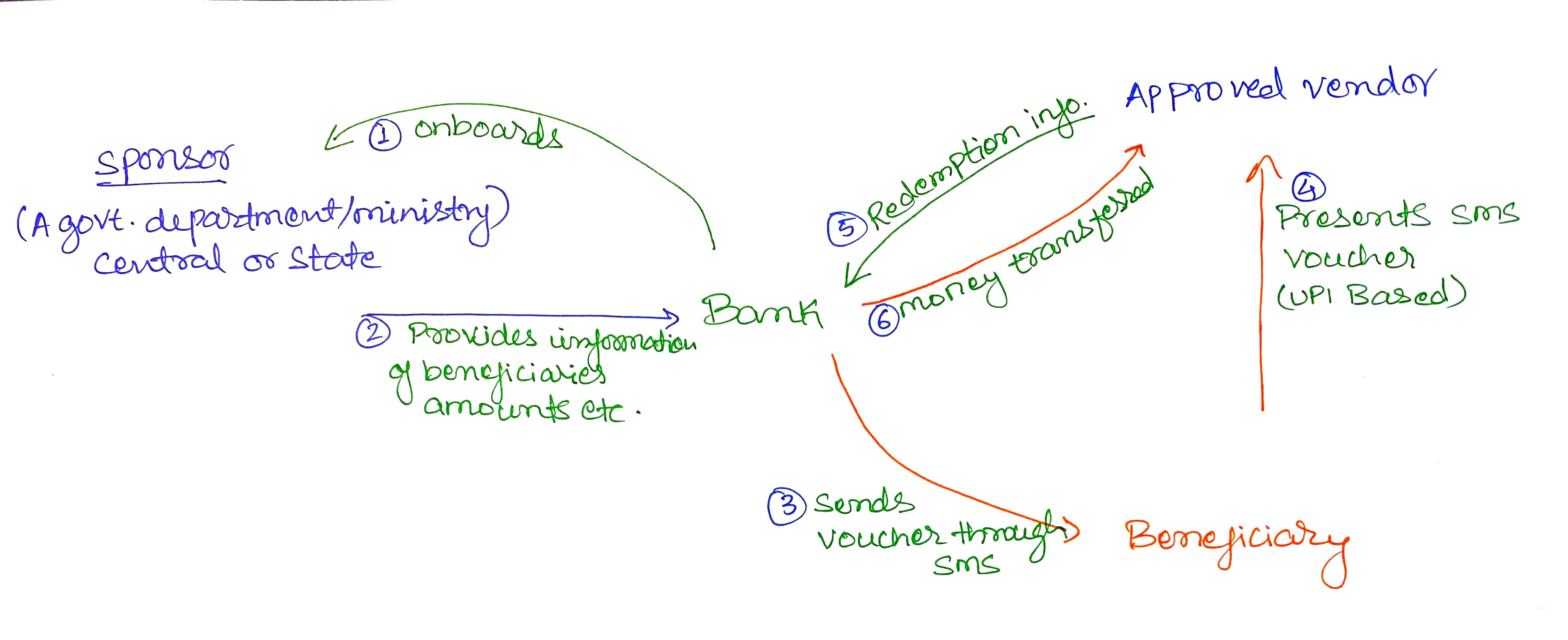
    So what is e₹UPI? It is something which is intended to bring efficiency to Direct Balance Transfers (DBT) by the goverment. IT uses the UPI infra and hence the name e₹’UPI‘. Below is a simple 6 stage flowchart of how it will work.

    (Ignore the colours, they don’t denote anything)

    The process will start with a government, ministry, or department coming on board as a sponsor for a program. Let’s assume, the Dept of Basic Education for Uttar Pradesh decides to adopt e₹UPI for distributing the money they spend on each student to provide them with Books for each academic year. The department will provide the details of all such student beneficiaries, along with a mobile number, amount, validity, approved vendors etc to the Bank. The Bank’s portal integrated with NPCI, will issue SMS based, UPI-prepaid voucher to each beneficiary. Upon receipt of the voucher, the student can only redeem it at a pre-approved book-seller in the area.

    This is how it is working in the current phase. However, it is expected that in the next phase it will allow for easier vendor selection/appointment and might open up a wider set of institutions to come on board as Sponsors. Imagine a private sector employer wants to reimburse its employees for certain healthcare expenses (eg: COVID vaccination). While the employer doesn’t want to go through the hassle of processing reimbursement but at the same time has to reasonably ensure the money is not spent for other purposes. Such an employer can come on-board e₹UPI and issue vouchers to its employees, who can only redeem their vouchers with Hospitals in their city. It has certain limitations in its current form but I think its benefits far outweigh any limitations. More on this in the next post.

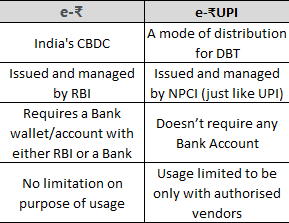
    Basic differences between the two
  • What does the future of e₹ look like?

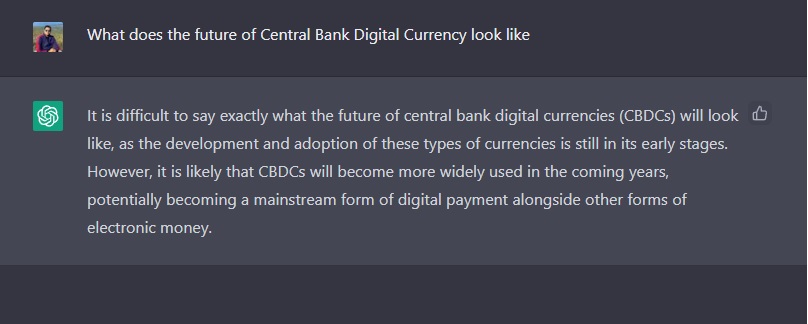
    An AI engine's output to the text prompt- Central Bank Digital Currency

    Let’s try some crystal gazing with what we know and have seen so far for India’s CBDC.

    Given the limits of my knowledge and imagination, I only see a few use cases where e₹ could have some legit application, at least in the near future. Firstly, I do not see any notable adoption happening for e₹-R. There are no significant benefits that it brings to customers, in a country that has UPI and other such infra in place. So that’s out of the window and we are left with e₹-W. With e₹-W, I could see a few interesting use cases. I am sharing a few to trigger your imagination.

    A. Tax Payments– In the wholesale segment, RBI might offer companies to hold a certain e₹ balance, which can be used to make tax payments back to RBI (for Govt of India). The reason, this seems likely is that with the introduction of TIN 2.0, RBI seems to be ousting banks from the business of handling tax flows. It is a lucrative business for the Banks and all have been investing and developing tools to make it simpler and easier for wholesale customers. With TIN 2.0 however, it appears that the role bank’s have played in this transaction is being reduced. Offering companies an option to maintain an e₹ account to pay taxes might give them a 24hr flexibility and faster realization to RBI. On the other hand, it will have a relatively negligible impact on the corporates. This might pick up since it seems to be the simplest application to implement.

    B. Large value inter-bank transactions– I think the most interesting use cases will emerge in this space. Primarily because- given the quantum, settlement and liquidity risks are at play and e₹ might help mitigate those risks.

    In the world of Supply Chain Finance- often for large exposures Banks enter into what is called as ‘Risk Participation’. In a typical large value setup, one of the banks would also be acting as the ‘Agent Bank’, that is to facilitate the disbursement and repayment to/from the Borrower to/from the participating banks. In the chain of transactions, typically for repayments from the borrower, the participating banks will run a settlement risk on the Agent Bank. If such a transaction happens through CBDC/e₹ teh agreement between banks could be made in such a way as to minimise this elemnt of settlement risk on the Agent Bank. Of course this same logic could be extended to a simpler consortium banking setup as well, to reduce the risk particpating banks run on the consortium leader bank.

    On the other hand, a whole new world of possibilities will open up for large escrow-based transactions, only if a Bank/Fintech could come up with a solution to operate an e₹ account with RBI under an escrow mechanism. Innovation from the private space will be needed since I don’t think RBI will ever be interested in managing such messy setups.

    So may be Escrows will be the way e₹ realises it’s true potential- who knows!

    P.S: Have been trying #ChatGPT and here is its response on the future of CBDCs. As good as almost anyone has to say!!

    Do try, if you haven’t already- #ChatGPT. Also, if you think that e₹ has applications in Direct Benefit Transfer- in my next, I will share why I don’t think so and there is a better solution already available for that.

  • e₹-R is here!

    My short and hot take on the newly launched e₹-R.

    By now you guys would have read that RBI launched the e₹-R pilot on Dec 01, 2022. Here are the details of the pilot from RBI- https://lifeofaguineapig.wordpress.com/wp-content/uploads/2022/12/pr12755768c88d86624673a14b2c7f5cf68908.pdf

    I sincerely hope that’s not the case, but to my limited understanding as of now, I fear this might be true!

    This above example was brought up by a colleague while we were discussing e₹-R.

    SBI’s Pilot e₹-R walkthrough
  • e₹- CBDC- How? Part-3

    e₹- CBDC- How? Part-3

    Significant development since the last post- RBI has been surprisingly on schedule, with the pilot for e₹-R which was kicked off on Dec 01, 2022.

    All hullabaloo around the more public pilot would have raised more, rather than answer questions. Let me contribute to your confusion (remember, the devil is in the details!). So, moving to the third dilemma which Central banks around the world and RBI closer home need to address before this new idea can earn some significance.

    Dilemma No 3RBI’s AnswerRationale
    Should the e₹ be interest bearing or not? e₹ balances will be non-interest bearing RBI wants the e₹ to taste and smell like fiat currency to the extent possible. Since, currency notes (in your wallet or vault) dont earn any inerest, so will be e₹.

    If you don’t see any problem with the above approach, consider the following-

    Why would you hold any significant amount in e₹ balance? Remember, despite RBI’s wish for e₹ to compete with Cash, what it is really up against, is the digital rupee and services such as UPI/IMPS/RTGS, etc.

    On the other hand, if it was an interest-bearing option, it would lead to pricing pressure on commercial banks. In other words, banks will have to offer a higher delta to make their deposits look attractive. If that happens, the Cost of funds for banks will go up, and consequently, the cost of lending too will have to be increased, and there lies RBI’s dilemma. RBI does not want CBDCs to lead to increased cost of borrowing for the industry.

    Moving on, dilemma no 4– If RBI pushes the USP of ‘Finality of settlement’ too much (which btw is the most important feature of e₹) it will in some ways undermine the Banks which RBI has spent so many years developing. The finality of settlement becomes prominent only if there is significant risk perceived in the financial standing of the Commercial banks involved in a transaction. If that is the case, RBI will have a bigger problem at hand. I don’t think they would want to disenfranchise banks that they have worked so hard to build by overplaying the finality of settlement (which btw is only relevant to e₹-W).

    In the next and hopefully the last of this series, I will try to share my take on the future of e₹.

  • e₹- CBDC- How? Part-2

    Picking up from where we left off in the last post. The indirect model
    will pose certain challenges for the e₹-R such as the following:

    1. It will have almost no difference compared to the current rupee in
      digital form (read your account balance in a savings account with any
      commercial bank).
    2. Your e₹ balances will not be updated with RBI in real-time thereby taking away one of the biggest USPs, i.e finality of settlement (the user will run the Settlement Risk in this model).

    To overcome these challenges the model most likely to be implemented for the retail pilot is a Hybrid model. Before you ask what this hybrid model is, let’s see in some detail about all three models- direct, indirect & hybrid.

    AspectDirectIndirectHybrid
    IssuerRBIRBI issues to Intermediary for retail distributionRBI issues to Intermediary for retail distribution
    LiabilityRBIRBIRBI
    OperationsRBIIntermediary Banks/InstitutionsIntermediary Banks/Institutions
    Who maintains the Ledger?RBIIntermediary
    Banks/Institutions
    Intermediary
    Banks/Institutions & RBI
    Settlement Finality YesNoYes
    The Three Distribution Models

    The reason I think a Hybrid model suits better is that the indirect model does away with almost all the benefits that a Retail user might want from e₹. So what is
    even the point? The Hybrid model, simply put is an indirect model with a messaging layer with it. Using this messaging layer, RBI will be able to keep a real-time ledger for each retail user. You can think of this as an e₹ account with a Commercial Bank along with a UPI-like layer to it which will update any transaction with RBI.

    Now, dilemma no 2- this pertains to the token design. Should the e₹ have a token-based design like all major cryptocurrencies or should have an account-based design that enables book-keeping as well?

    Dilemma No 2 RBI’s Answer Rationale
    Should the e₹ have a token-based design or an account-based design Account-Based for the Wholesale segment for
    now and probably it will be Token-based for the Retail segment.
    e₹ should offer the level of anonymity Cash offers. In the retail segment, RBI is trying to achieve lower Cash circulation by introducing e₹. To that end, a token-based e₹ will offer the holder, the right to spend without having to maintain a trail of the transactions.

    This is easier said than done! Such an approach (token-based) will also have lots of decisions to be made- such as whether should there be an amount ceiling for e₹-R, given the anonymity. More in the next post.