Tag: Financial inclusion

  • e-Rupee (e₹) or e-RUPI? (e₹UPI)

    Not being a wordsmith and these 2 are very different things! Short note on what’s what.

    So, first e-Rupee or e-₹; this is what has been the talk of the town for over a month now. Simply put, it is India’s CBDC (Central Bank Digital Currency) launched by RBI, which is currently undergoing its pilot. {If you still wondering what is that, welcome to the blog and may I implore you to go through last few posts here. I beleive, that will be sufficient for you to gain a decent undertsanding of e₹. }. With e-₹ out of the way, what the hell is e-₹UPI!

    Continuing with our long national tradition of creating clutter as much and wherever possible we have done it again! Jokes apart and to be fair, there wasn’t much room for having a better nomenclature for these 2. Anyways, this Seeta-Geeta business has got more than a handful mixing the two and serving it to people. The very reason I wanted to write on this, was because a few days back I came across this on youtube- https://youtu.be/My5pXiDCtU0 from Mr. Akshat Shrivastava. Great channel, superb content, and 1.35 mn Subs on Youtube alone! 10 days later this video has 304K views and 1500+ comments appreciating the content. The only hitch is that he has got it wrong, confusing e₹UPI as India’s CBDC.

    Don’t get me wrong, I love his content and general take on life but this was a reason enough to make an effort to limit the misinformation. Enough digression, back to the subject.

    e₹UPI was first announced by Prime Minister Narendra Modi on 2nd Aug 2021. Long before the e-Rupee (e₹) came into being.
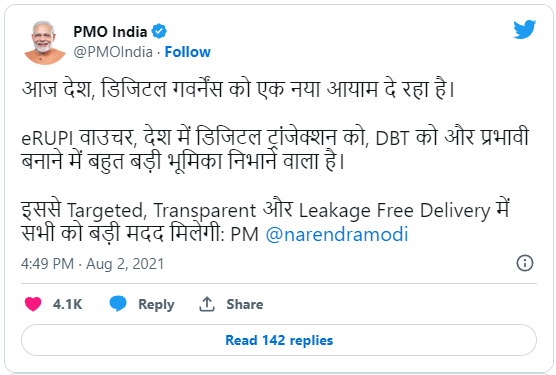
    So what is e₹UPI? It is something which is intended to bring efficiency to Direct Balance Transfers (DBT) by the goverment. IT uses the UPI infra and hence the name e₹’UPI‘. Below is a simple 6 stage flowchart of how it will work.
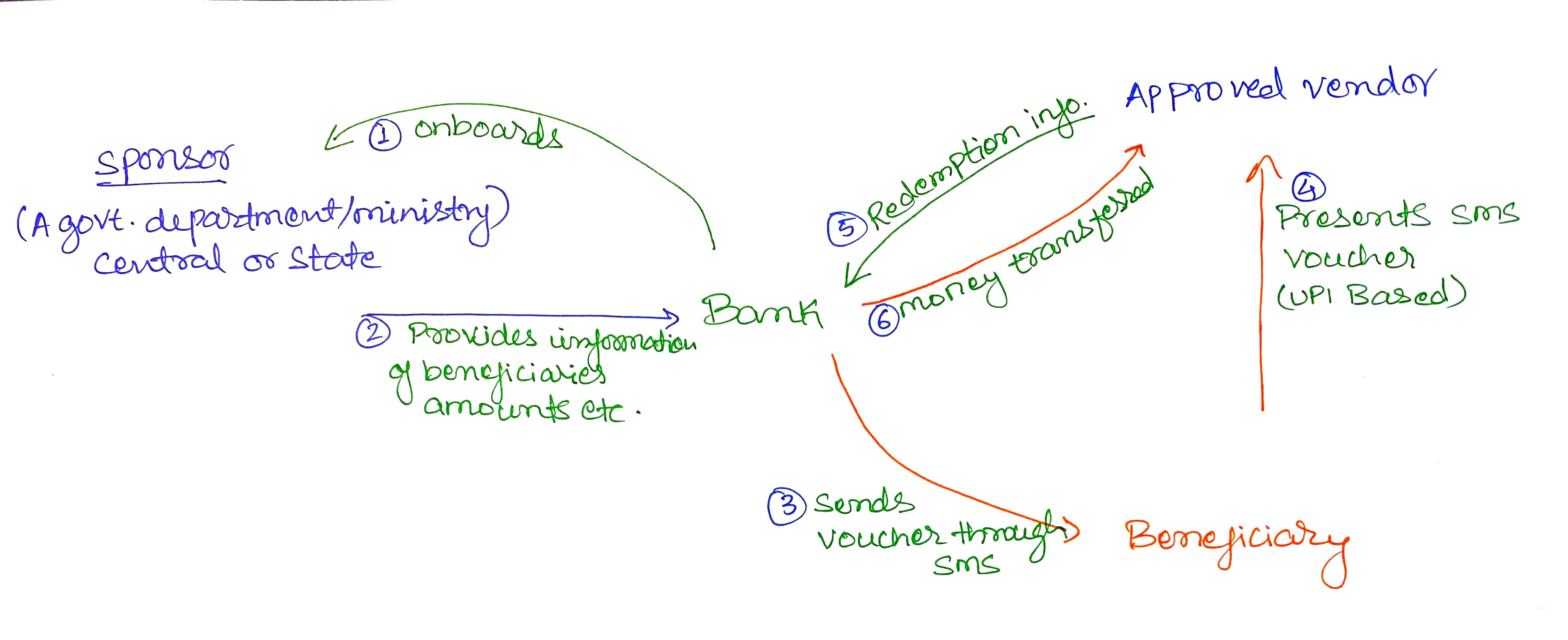
    (Ignore the colours, they don’t denote anything)

    The process will start with a government, ministry, or department coming on board as a sponsor for a program. Let’s assume, the Dept of Basic Education for Uttar Pradesh decides to adopt e₹UPI for distributing the money they spend on each student to provide them with Books for each academic year. The department will provide the details of all such student beneficiaries, along with a mobile number, amount, validity, approved vendors etc to the Bank. The Bank’s portal integrated with NPCI, will issue SMS based, UPI-prepaid voucher to each beneficiary. Upon receipt of the voucher, the student can only redeem it at a pre-approved book-seller in the area.

    This is how it is working in the current phase. However, it is expected that in the next phase it will allow for easier vendor selection/appointment and might open up a wider set of institutions to come on board as Sponsors. Imagine a private sector employer wants to reimburse its employees for certain healthcare expenses (eg: COVID vaccination). While the employer doesn’t want to go through the hassle of processing reimbursement but at the same time has to reasonably ensure the money is not spent for other purposes. Such an employer can come on-board e₹UPI and issue vouchers to its employees, who can only redeem their vouchers with Hospitals in their city. It has certain limitations in its current form but I think its benefits far outweigh any limitations. More on this in the next post.
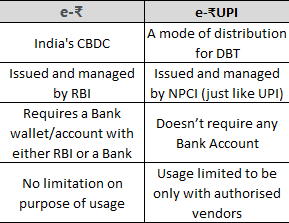
    Basic differences between the two
  • What is Financial Inclusion?

    Ok..so before I run out of my josh to blog let’s get something useful here 🙂

    So what is this ‘Financial Inclusion’ that the newspapers keep talking about?

    Financial Inclusion in simple words is the idea of providing banking services at very low costs to the poor. So now the next question comes that why has it become so important all of sudden that every bank is talking about it? Well largely the reason why every bank is talking about it is because their banker i.e RBI wants them to do so!  The reason behind  this move is again pretty simple- the ratio of number of current & savings a/c to adult population in our country is still low (it is .59 as per the last census data of 2000 & no of a/c as of 2004). The urban population has a fair access to banking services, and since providing them these services is more profitable even the banks prefer serving the urban population. Now some stats to substantiate what we are trying to say- only 39% of rural adult population has access to a/c as compared to 60% in urban areas. Still worse, only 14% of Indian adult population has a loan account with a bank which again for rural population is as low as 9.5%!

    Most of the commercial banks except for regional rural banks have stayed away from serving the rural population, the reason is quite apparent too- 44% of total deposits come from the top six metros! So, the grand daddy of all banks RBI steps in to tell them what they need to do in order to provide the poor in semi-urban & rural areas access to banking. Banks were told to offer ‘no-frills’ savings a/c to the poor and given targets to increase their number of accounts. There are many ways in which the RBI is trying to push the banks towards the goal of inclusion. It has relaxed the norms of KYC for a/c with deposits less than Rs. 50,000. Other important steps have been, allowing RRBs’( Regional Rural Banks) / Co-operative banks to sell Insurance and Financial Products, Relaxing norms for ATM, Kisan Credit cards etc. But the most significant thing that RBI is ‘banking’ on is technology! They are hoping things like mobile technology will help the banks to reduce their cost of providing the service, thereby making it a profitable proposition for them.

    Now what has prevented the banks from doing that in the past? I guess it’s not difficult to understand the high transaction cost incurred by the banks in providing these services to the poor. Also there is a limitation in providing cash access points. But it’s not that this sector can’t be serviced profitably. We have had organisations like Sewa Bank of Gujarat which have shown that providing services to this segment can also be profitable. Then the world third world also witnessed great microfinance revolution, which again reinforced the idea. The main motive is to relieve the under privileged from the clutches of moneylenders, pawn brokers etc (how successful we are in that attempt we ll see that later). Now the aim is to provide services like credit, insurance, health care/life insurance to this segment at an affordable cost so that they can also join the growth run that we are having. Probably only then we can boast of our GDP growth rates in real sense.

    Going forward I will try to touch upon what is microfinance and other related topics. My apologies for my myopic view on the topic, as it only talks about India. It is so because I intended to keep it that way 🙂 .