
Let’s try some crystal gazing with what we know and have seen so far for India’s CBDC.
Given the limits of my knowledge and imagination, I only see a few use cases where e₹ could have some legit application, at least in the near future. Firstly, I do not see any notable adoption happening for e₹-R. There are no significant benefits that it brings to customers, in a country that has UPI and other such infra in place. So that’s out of the window and we are left with e₹-W. With e₹-W, I could see a few interesting use cases. I am sharing a few to trigger your imagination.
A. Tax Payments– In the wholesale segment, RBI might offer companies to hold a certain e₹ balance, which can be used to make tax payments back to RBI (for Govt of India). The reason, this seems likely is that with the introduction of TIN 2.0, RBI seems to be ousting banks from the business of handling tax flows. It is a lucrative business for the Banks and all have been investing and developing tools to make it simpler and easier for wholesale customers. With TIN 2.0 however, it appears that the role bank’s have played in this transaction is being reduced. Offering companies an option to maintain an e₹ account to pay taxes might give them a 24hr flexibility and faster realization to RBI. On the other hand, it will have a relatively negligible impact on the corporates. This might pick up since it seems to be the simplest application to implement.
B. Large value inter-bank transactions– I think the most interesting use cases will emerge in this space. Primarily because- given the quantum, settlement and liquidity risks are at play and e₹ might help mitigate those risks.
In the world of Supply Chain Finance- often for large exposures Banks enter into what is called as ‘Risk Participation’. In a typical large value setup, one of the banks would also be acting as the ‘Agent Bank’, that is to facilitate the disbursement and repayment to/from the Borrower to/from the participating banks. In the chain of transactions, typically for repayments from the borrower, the participating banks will run a settlement risk on the Agent Bank. If such a transaction happens through CBDC/e₹ teh agreement between banks could be made in such a way as to minimise this elemnt of settlement risk on the Agent Bank. Of course this same logic could be extended to a simpler consortium banking setup as well, to reduce the risk particpating banks run on the consortium leader bank.
On the other hand, a whole new world of possibilities will open up for large escrow-based transactions, only if a Bank/Fintech could come up with a solution to operate an e₹ account with RBI under an escrow mechanism. Innovation from the private space will be needed since I don’t think RBI will ever be interested in managing such messy setups.
So may be Escrows will be the way e₹ realises it’s true potential- who knows!
P.S: Have been trying #ChatGPT and here is its response on the future of CBDCs. As good as almost anyone has to say!!
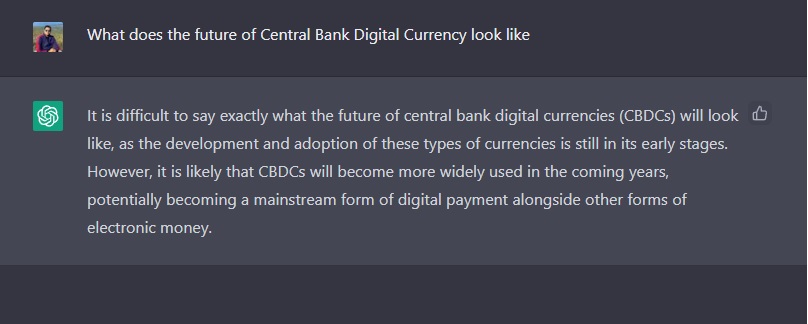
Do try, if you haven’t already- #ChatGPT. Also, if you think that e₹ has applications in Direct Benefit Transfer- in my next, I will share why I don’t think so and there is a better solution already available for that.