Tag: CBDC

  • e-Rupee (e₹) or e-RUPI? (e₹UPI)

    Not being a wordsmith and these 2 are very different things! Short note on what’s what.

    So, first e-Rupee or e-₹; this is what has been the talk of the town for over a month now. Simply put, it is India’s CBDC (Central Bank Digital Currency) launched by RBI, which is currently undergoing its pilot. {If you still wondering what is that, welcome to the blog and may I implore you to go through last few posts here. I beleive, that will be sufficient for you to gain a decent undertsanding of e₹. }. With e-₹ out of the way, what the hell is e-₹UPI!

    Continuing with our long national tradition of creating clutter as much and wherever possible we have done it again! Jokes apart and to be fair, there wasn’t much room for having a better nomenclature for these 2. Anyways, this Seeta-Geeta business has got more than a handful mixing the two and serving it to people. The very reason I wanted to write on this, was because a few days back I came across this on youtube- https://youtu.be/My5pXiDCtU0 from Mr. Akshat Shrivastava. Great channel, superb content, and 1.35 mn Subs on Youtube alone! 10 days later this video has 304K views and 1500+ comments appreciating the content. The only hitch is that he has got it wrong, confusing e₹UPI as India’s CBDC.

    Don’t get me wrong, I love his content and general take on life but this was a reason enough to make an effort to limit the misinformation. Enough digression, back to the subject.

    e₹UPI was first announced by Prime Minister Narendra Modi on 2nd Aug 2021. Long before the e-Rupee (e₹) came into being.
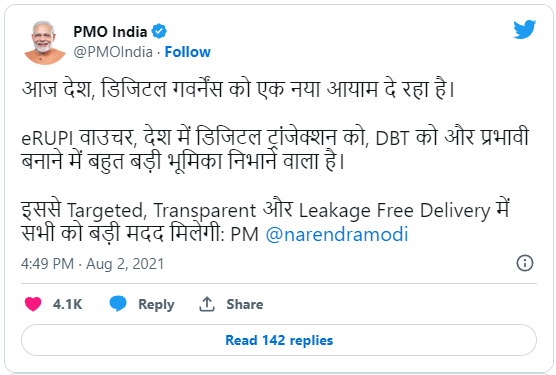
    So what is e₹UPI? It is something which is intended to bring efficiency to Direct Balance Transfers (DBT) by the goverment. IT uses the UPI infra and hence the name e₹’UPI‘. Below is a simple 6 stage flowchart of how it will work.
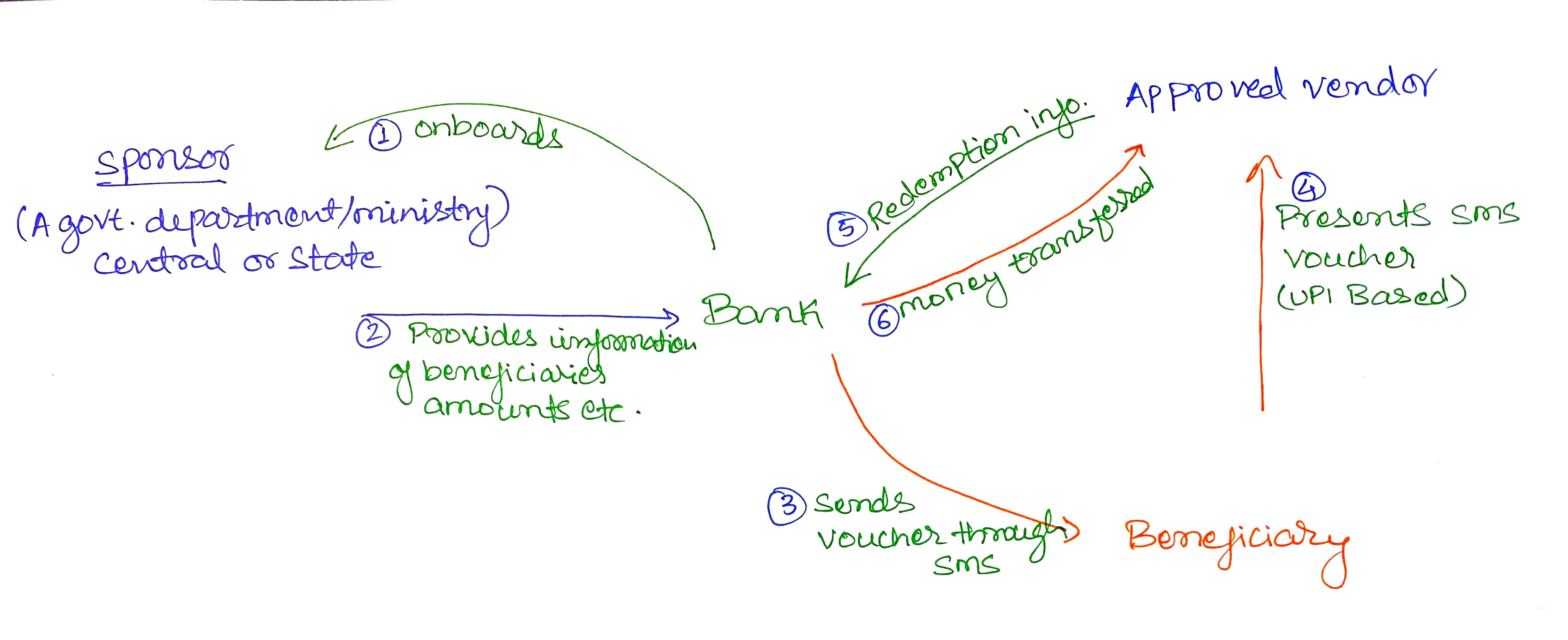
    (Ignore the colours, they don’t denote anything)

    The process will start with a government, ministry, or department coming on board as a sponsor for a program. Let’s assume, the Dept of Basic Education for Uttar Pradesh decides to adopt e₹UPI for distributing the money they spend on each student to provide them with Books for each academic year. The department will provide the details of all such student beneficiaries, along with a mobile number, amount, validity, approved vendors etc to the Bank. The Bank’s portal integrated with NPCI, will issue SMS based, UPI-prepaid voucher to each beneficiary. Upon receipt of the voucher, the student can only redeem it at a pre-approved book-seller in the area.

    This is how it is working in the current phase. However, it is expected that in the next phase it will allow for easier vendor selection/appointment and might open up a wider set of institutions to come on board as Sponsors. Imagine a private sector employer wants to reimburse its employees for certain healthcare expenses (eg: COVID vaccination). While the employer doesn’t want to go through the hassle of processing reimbursement but at the same time has to reasonably ensure the money is not spent for other purposes. Such an employer can come on-board e₹UPI and issue vouchers to its employees, who can only redeem their vouchers with Hospitals in their city. It has certain limitations in its current form but I think its benefits far outweigh any limitations. More on this in the next post.
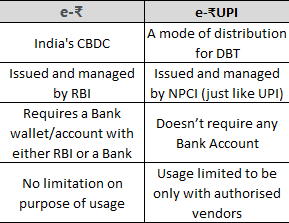
    Basic differences between the two
  • What does the future of e₹ look like?

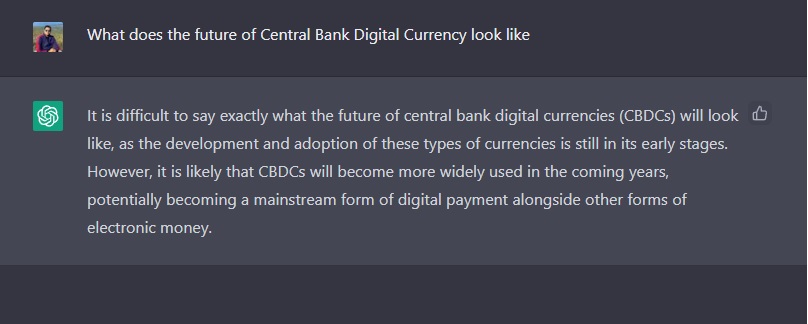
    An AI engine's output to the text prompt- Central Bank Digital Currency

    Let’s try some crystal gazing with what we know and have seen so far for India’s CBDC.

    Given the limits of my knowledge and imagination, I only see a few use cases where e₹ could have some legit application, at least in the near future. Firstly, I do not see any notable adoption happening for e₹-R. There are no significant benefits that it brings to customers, in a country that has UPI and other such infra in place. So that’s out of the window and we are left with e₹-W. With e₹-W, I could see a few interesting use cases. I am sharing a few to trigger your imagination.

    A. Tax Payments– In the wholesale segment, RBI might offer companies to hold a certain e₹ balance, which can be used to make tax payments back to RBI (for Govt of India). The reason, this seems likely is that with the introduction of TIN 2.0, RBI seems to be ousting banks from the business of handling tax flows. It is a lucrative business for the Banks and all have been investing and developing tools to make it simpler and easier for wholesale customers. With TIN 2.0 however, it appears that the role bank’s have played in this transaction is being reduced. Offering companies an option to maintain an e₹ account to pay taxes might give them a 24hr flexibility and faster realization to RBI. On the other hand, it will have a relatively negligible impact on the corporates. This might pick up since it seems to be the simplest application to implement.

    B. Large value inter-bank transactions– I think the most interesting use cases will emerge in this space. Primarily because- given the quantum, settlement and liquidity risks are at play and e₹ might help mitigate those risks.

    In the world of Supply Chain Finance- often for large exposures Banks enter into what is called as ‘Risk Participation’. In a typical large value setup, one of the banks would also be acting as the ‘Agent Bank’, that is to facilitate the disbursement and repayment to/from the Borrower to/from the participating banks. In the chain of transactions, typically for repayments from the borrower, the participating banks will run a settlement risk on the Agent Bank. If such a transaction happens through CBDC/e₹ teh agreement between banks could be made in such a way as to minimise this elemnt of settlement risk on the Agent Bank. Of course this same logic could be extended to a simpler consortium banking setup as well, to reduce the risk particpating banks run on the consortium leader bank.

    On the other hand, a whole new world of possibilities will open up for large escrow-based transactions, only if a Bank/Fintech could come up with a solution to operate an e₹ account with RBI under an escrow mechanism. Innovation from the private space will be needed since I don’t think RBI will ever be interested in managing such messy setups.

    So may be Escrows will be the way e₹ realises it’s true potential- who knows!

    P.S: Have been trying #ChatGPT and here is its response on the future of CBDCs. As good as almost anyone has to say!!

    Do try, if you haven’t already- #ChatGPT. Also, if you think that e₹ has applications in Direct Benefit Transfer- in my next, I will share why I don’t think so and there is a better solution already available for that.

  • e₹- CBDC- How? Part-3

    e₹- CBDC- How? Part-3

    Significant development since the last post- RBI has been surprisingly on schedule, with the pilot for e₹-R which was kicked off on Dec 01, 2022.

    All hullabaloo around the more public pilot would have raised more, rather than answer questions. Let me contribute to your confusion (remember, the devil is in the details!). So, moving to the third dilemma which Central banks around the world and RBI closer home need to address before this new idea can earn some significance.

    Dilemma No 3RBI’s AnswerRationale
    Should the e₹ be interest bearing or not? e₹ balances will be non-interest bearing RBI wants the e₹ to taste and smell like fiat currency to the extent possible. Since, currency notes (in your wallet or vault) dont earn any inerest, so will be e₹.

    If you don’t see any problem with the above approach, consider the following-

    Why would you hold any significant amount in e₹ balance? Remember, despite RBI’s wish for e₹ to compete with Cash, what it is really up against, is the digital rupee and services such as UPI/IMPS/RTGS, etc.

    On the other hand, if it was an interest-bearing option, it would lead to pricing pressure on commercial banks. In other words, banks will have to offer a higher delta to make their deposits look attractive. If that happens, the Cost of funds for banks will go up, and consequently, the cost of lending too will have to be increased, and there lies RBI’s dilemma. RBI does not want CBDCs to lead to increased cost of borrowing for the industry.

    Moving on, dilemma no 4– If RBI pushes the USP of ‘Finality of settlement’ too much (which btw is the most important feature of e₹) it will in some ways undermine the Banks which RBI has spent so many years developing. The finality of settlement becomes prominent only if there is significant risk perceived in the financial standing of the Commercial banks involved in a transaction. If that is the case, RBI will have a bigger problem at hand. I don’t think they would want to disenfranchise banks that they have worked so hard to build by overplaying the finality of settlement (which btw is only relevant to e₹-W).

    In the next and hopefully the last of this series, I will try to share my take on the future of e₹.

  • e₹- CBDC- How? Part-2

    Picking up from where we left off in the last post. The indirect model
    will pose certain challenges for the e₹-R such as the following:

    1. It will have almost no difference compared to the current rupee in
      digital form (read your account balance in a savings account with any
      commercial bank).
    2. Your e₹ balances will not be updated with RBI in real-time thereby taking away one of the biggest USPs, i.e finality of settlement (the user will run the Settlement Risk in this model).

    To overcome these challenges the model most likely to be implemented for the retail pilot is a Hybrid model. Before you ask what this hybrid model is, let’s see in some detail about all three models- direct, indirect & hybrid.

    AspectDirectIndirectHybrid
    IssuerRBIRBI issues to Intermediary for retail distributionRBI issues to Intermediary for retail distribution
    LiabilityRBIRBIRBI
    OperationsRBIIntermediary Banks/InstitutionsIntermediary Banks/Institutions
    Who maintains the Ledger?RBIIntermediary
    Banks/Institutions
    Intermediary
    Banks/Institutions & RBI
    Settlement Finality YesNoYes
    The Three Distribution Models

    The reason I think a Hybrid model suits better is that the indirect model does away with almost all the benefits that a Retail user might want from e₹. So what is
    even the point? The Hybrid model, simply put is an indirect model with a messaging layer with it. Using this messaging layer, RBI will be able to keep a real-time ledger for each retail user. You can think of this as an e₹ account with a Commercial Bank along with a UPI-like layer to it which will update any transaction with RBI.

    Now, dilemma no 2- this pertains to the token design. Should the e₹ have a token-based design like all major cryptocurrencies or should have an account-based design that enables book-keeping as well?

    Dilemma No 2 RBI’s Answer Rationale
    Should the e₹ have a token-based design or an account-based design Account-Based for the Wholesale segment for
    now and probably it will be Token-based for the Retail segment.
    e₹ should offer the level of anonymity Cash offers. In the retail segment, RBI is trying to achieve lower Cash circulation by introducing e₹. To that end, a token-based e₹ will offer the holder, the right to spend without having to maintain a trail of the transactions.

    This is easier said than done! Such an approach (token-based) will also have lots of decisions to be made- such as whether should there be an amount ceiling for e₹-R, given the anonymity. More in the next post.

  • e₹..CBDC?.. what’s that!

    CBDC has been a buzzword with RBI kicking off the pilot. I will try to explain the What, Why & How of RBI’s CBDC, which would be true for most CBDCs globally. In this first part, we will explore the What & Why of it and will do the How part in the following post. These posts will mainly refer to the concept document from RBI, released in October 2022 (https://rbidocs.rbi.org.in/rdocs/PublicationReport/Pdfs/CONCEPTNOTEACB531172E0B4DFC9A6E506C2C24FFB6.PDF), because that’s all there is when it comes to e₹.

    The first major mention of e-Rupee was in the Union Budget presented on 01st Feb, 2022. CBDC which stands for Central Bank Digital Currency is a global term used for legal tender issued by a central bank in digital form. e-Rupee is the name given to India’s CBDC.

    Let’s start with Why RBI considered coming up with its own CBDC. I see two primary reasons- the first is to bring about a reduction in cash circulation. Cash management- right from Cost (printing, distribution, etc) to logistics, is a costly and inefficient method that RBI is trying to disrupt (remember demonetization?..eh). The second and more pressing reason I am quoting it right from RBI’s note referred to in the opening para- As of July 2022, there are 105 countries8 in the process of exploring CBDC, a number that covers 95% of global Gross Domestic Product (GDP). 10 countries have launched a CBDC, the first of which was the Bahamian Sand Dollar in 2020 and the latest was Jamaica’s JAM-DEX.
    Currently, 17 other countries, including major economies like China and South Korea, are in the pilot stage and preparing for possible launches. China was the first large economy to pilot a CBDC in April 2020 and it aims for widespread domestic use of the e-CNY by 2023. 

    There is a reason why all countries are lining up in a hurry to come up with their CBDCs and it is what lies at the heart of the Blockchain/bitcoin revolution. The key word here is ‘decentralization’. As you might know, the primary motivation behind blockchain technology was the 2008 financial crisis and the general despise of the public against the ‘System’, which includes Banks- both commercial and central, Governments, etc. Thus, the idea of a decentralized currency was born of which Blockchain is the best-known example. While Bitcoin and many other such cryptocurrencies had a wild run since then, I have held a very strong opinion that no Sovereign will ever allow loss of control over Money! It is probably the most important control they have over the lives of their citizens and they will just not let it happen. Having said that, Blockchain technology will change the world (it already is..). I will save the larger discussion of Blockchain, Bitcoin, etc for another day. So in a nutshell, Governments/Central Banks don’t want a decentralized Crypto to grow which undermines their control. If you read the RBI concept note, there are more than sufficient words dedicated to explaining the oh! so very important functions the central banks undertake and how private cryptocurrencies pose a risk. Hope you can read what’s not spelled out. So that concludes my point on Why.

    Now let’s get to the What part. To understand what is CBDC/e-Rupee better, we should delve a bit into what is Currency/Rupee. Our fiat currency-Rupee acts as the following three-

    •        Store of Value
    •        Medium of payment
    •        Unit of Account

    So any new offering that tries to undertake functions of the Rupee, must fulfill the above 3 roles. I will straight get to the biggest question that I have had when I heard e₹ for the first time and I presume most other people would have the same question as well- How is it different from the money in my Paytm wallet or my savings account balance in my Kotak Mahindra Savings account? The key difference between the two is-

    CBDC is issued by the Central Bank just like the physical rupee, whereas the balances we see in our accounts with Banks or wallets are provided by the Commercial entity we are dealing with. Simply put, the balance in Paytm wallet is as good as Paytm whereas the e₹ is as good as RBI. You can extend the logic to answer your specific case. All other differences stem from this key difference-

    1. e₹ is the liability of RBI whereas others are the liability of their respective institutions. 
    2. e₹ will only carry sovereign credit risk, whereas the other also carries counter-party risks (Settlement risk, solvency risk, etc).
    3. e₹ account will be maintained with the Central Bank whereas the other (digital rupee) is held with commercial banks. (There is one finer point to keep in mind that we will note in the next post on How.  

    Hope I have been able to answer some questions about the Why & What that you had. Will follow up with How, in the next post. 

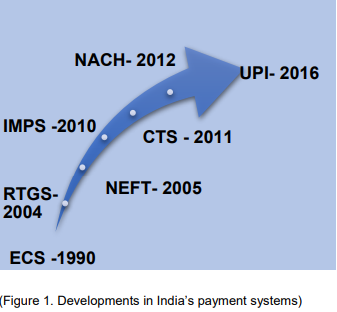
    Side note- the most unimpressive way to depict an impressive feat is straight from RBI’s concept note:

    Screenshot_20221112_204720